

U.S. Container Ports Rebound Strongly, Surpassing Pre-Pandemic Levels
Despite ongoing geopolitical volatility and rising logistics costs, U.S. container ports are demonstrating remarkable resilience. The latest data shows that cargo volumes have not only returned to a growth trajectory but have also exceeded pre-pandemic levels—reaffirming the United States’ position as one of the world’s leading logistics hubs and a cornerstone of the global economy.
According to the August 2025 report by the Pacific Maritime Association (PMA), major U.S. container port systems are recording a strong recovery in both throughput and operational capacity.
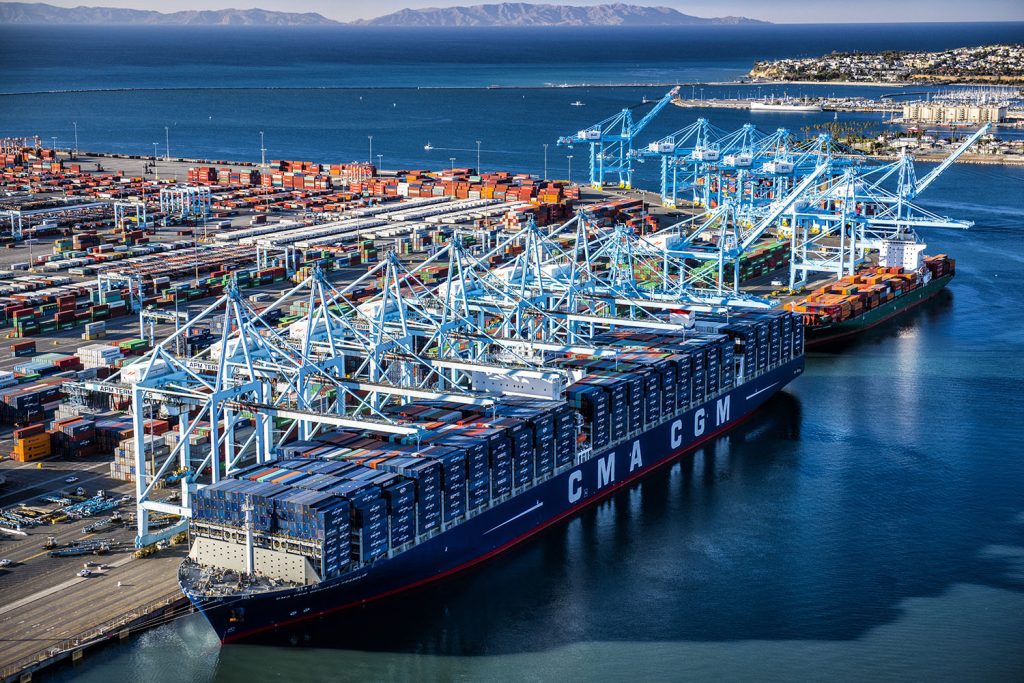
On the West Coast, the Port of Los Angeles–Long Beach complex continues to serve as the nation’s primary gateway.
The Port of Los Angeles handled 504,514 import TEUs in August—down slightly by 1% year-on-year, yet up 15.3% compared to August 2019.
The Port of Long Beach processed 440,318 TEUs, a decrease of 3.6% year-on-year but still 36.4% higher than pre-pandemic levels.
Combined, the San Pedro Bay gateway recorded 944,832 import TEUs, down just 2.2% from last year while nearly 20% above 2019 volumes, clearly illustrating the region’s strong recovery capacity.
The Port of Oakland (California) showed a more subdued performance, handling 82,245 import TEUs, down 1.2% year-on-year and 6.9% below 2019 levels.
In the Pacific Northwest, the Northwest Seaport Alliance (Tacoma–Seattle) reported 93,003 TEUs, representing a sharp decline of 24.8% year-on-year and 17.2% compared to 2019, reflecting the impact of global route realignments and higher port-related costs.
In contrast, East Coast and Gulf Coast ports are accelerating rapidly.
The Port of New York–New Jersey handled 416,009 import TEUs in August, up 5.2% year-on-year and 21.4% above pre-pandemic levels.
The Port of Virginia recorded 140,055 TEUs, down 8.3% from last year but still 15.2% higher than before the pandemic.
Meanwhile, the Port of Houston saw a 3.9% year-on-year increase, reaching 169,631 TEUs—equivalent to a 53.8% increase compared to six years ago, driven by strategic investments in port infrastructure and logistics networks.
This recovery trend extends beyond the United States. In Canada, the Port of Vancouver handled 151,273 import TEUs in August, up 2.8% year-on-year and 3.7% above 2019 levels.
The Port of Prince Rupert processed 43,833 TEUs, up 23.1% from last year, though still 38.7% below pre-pandemic volumes.
According to Transport Canada, total container throughput across British Columbia ports reached 2.54 million TEUs in the first eight months of the year, marking an 11% increase compared to 2019.
Industry experts attribute this strong rebound to sustained domestic consumption, increased investment in port infrastructure, and ongoing efforts to restructure supply chains following global disruptions. A report by Drewry Shipping Consultants indicates that container volumes through U.S. West Coast ports in 2025 rose 14% year-on-year, despite logistics costs increasing by more than 30% compared to the 2019–2020 period.
However, the outlook remains subject to uncertainty. Alphaliner (2025) warns that the shift of shipping services from the West Coast to the East Coast is likely to continue, driven by geopolitical risks and supply chain congestion in the Pacific. At the same time, the World Shipping Council notes that conflicts in the Red Sea and fuel price volatility are affecting global freight rates and transit times.
Nevertheless, the robust recovery of U.S. and Canadian ports is widely viewed as a positive signal for the global supply chain—including Vietnam, which is steadily increasing exports to the North American market. Closely monitoring developments at these major gateway ports will be critical for Vietnamese logistics providers and exporters to proactively plan transportation strategies and optimize end-to-end supply chain costs.
Source: FreightWaves